The Eight Seconds Everyone Saw
I’ve spent fifteen years in buildings where robots fall over. That’s most of what I’ve watched them do: they wobble, they go down, somebody walks out and stands them back up. So when the clip went around this summer — a humanoid running 100 meters in 8.64 seconds, against Usain Bolt’s 9.58 — I watched it like everyone else, and then I went looking for the rest of the footage.
The robot is Tiangong Ultra, built by the Beijing Humanoid Robot Innovation Center, and it ran that time at the World Humanoid Robot Games. It earned it, too. It took its own mark from 9.39 to 8.86 to 8.64 across the meet, and a year earlier, at the first edition of those Games, the best anyone managed was over twelve seconds. Three seconds in twelve months isn’t a gimmick. It’s a startling curve, and the teams who drew it weren’t pretending otherwise.
Then the runners crossed the line. Several of them, the champion included, hit the padded barrier past it. Sparks came off some of the machines. Staff ran on with fire extinguishers, sprayed the ones lying on the ground, and the robots went off on stretchers.
Both halves are true. Only one made the highlight reel.
I’m not here to dunk on a robot that fell over, and China’s robots aren’t overrated — they’re the real thing. The problem is what we chose to measure, and the gap that choice has opened between what people think humanoid robots can do and what you can actually ask one to do today.
Why I Get a View on This
I should put my position on the table, because it cuts both ways.
I’m a Trustee of the RoboCup Federation. RoboCup sanctions the humanoid soccer that runs inside those Beijing Games — the 2nd RoboCup Asia-Pacific Beijing Masters was held in the same building in the same week, co-organized with the Beijing Municipal Government. I’m not a neutral party here. I have a side, and it is on the field.
So let me be exact about who I’m arguing with. Not Beijing. The Games are a serious event run by serious people, and the teams there did the thing in public, which is more than most of this industry manages. The habit I want to argue with is ours, on the outside: watching a clip, feeling the jolt, and quietly updating an estimate the clip never supported.
Everything that follows is a personal view, from inside this sport. It isn’t the Federation’s position, and it isn’t my employer’s.
The Benchmark Ran Two Months Earlier, and Nobody Filmed It
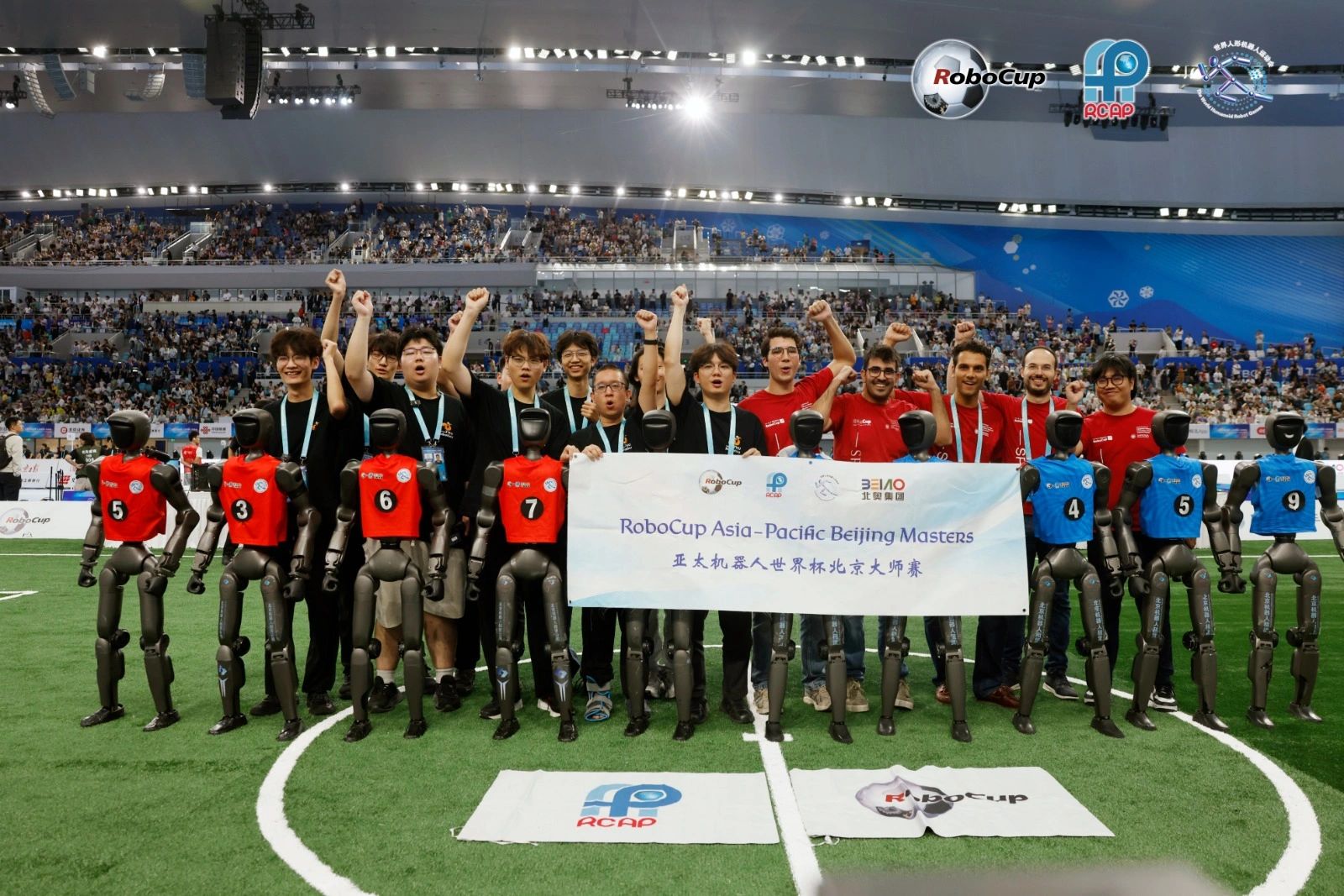
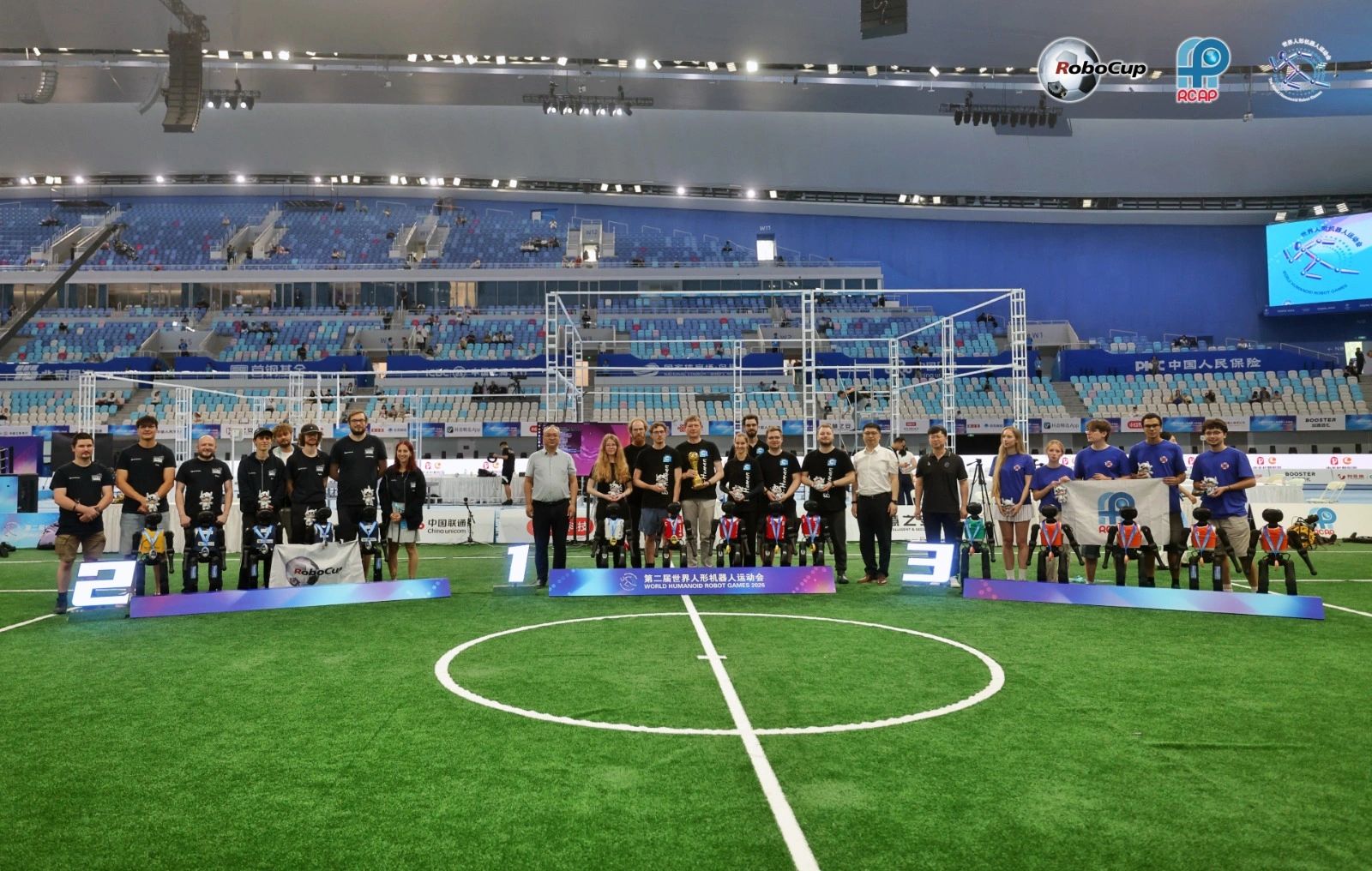
Two months before Beijing, at RoboCup 2026 in Incheon, something happened that I would argue matters more, and which you almost certainly didn’t see. On 5 July, two teams of humanoid robots played eleven-against-eleven on real hardware for the first time. B-Human from Bremen beat HTWK Robots from Leipzig, 4–0. I wrote about that day.
It doesn’t look like much. The honest description, from a reporter who was there, is “small, wobbly players, not Messi.” That is fair, and our Federation President, Ubbo Visser, was careful in the same direction: the new hardware and the new level of intelligence put humanoid soccer “on another level” — the language of a step, not an arrival.
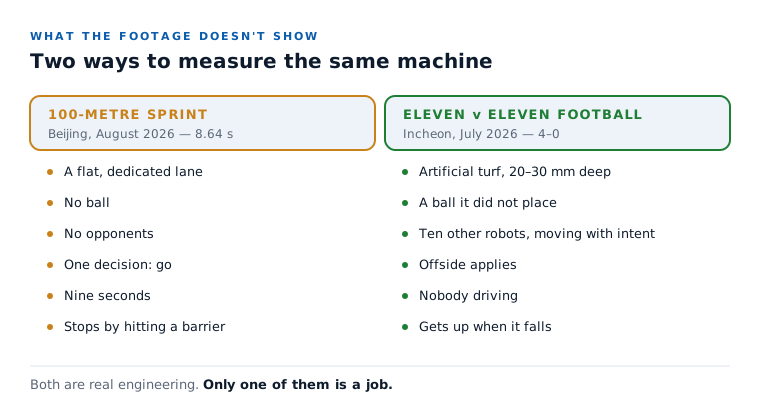
But look at what the machines were asked to do, because the rulebook is the argument.
RoboCup merged three of its leagues this year into a new Humanoid Soccer League. Its 2026 rules put the matches on artificial turf between 20 and 30 millimeters deep — not a track, not a polished floor, a surface that takes a foot and keeps some of it. The large division plays on a 22-by-14-meter pitch. There is an offside rule. A robot that wanders off the field gets a penalty.
So every robot out there had to walk on an uneven surface, find a ball nobody placed for it, model ten other machines moving with intent, decide where it ought to be rather than where the ball is, and do all of it with nobody driving. On a flat lane, alone, against a clock, none of those problems exist.
That is the whole thing in one comparison. A sprint is a machine at full commitment in a straight line. A match is a machine deciding, continuously, under uncertainty, among others. We built a spectacle around the first and a rulebook around the second, and then let the first one set the public’s sense of how close we are.
Don’t Time the Sprint. Time the Recovery.
The robots on the turf in Incheon fall down constantly. What has changed, across the fifteen years I have been watching, isn’t that they fall less. It is that every year they get up faster — quicker, more reliably, with less need for a human to walk over.
That is a boring number. It’ll never trend. It is also the one I would put on the wall, because it is the closest cheap proxy for what a workplace actually buys: uptime.
Now, the fair objection, and it is a good one. A sprinter is a specialist. It is tuned for peak output in a straight line, and the fact that it can’t stop tells you very little about whether some other machine could stack a pallet. Recovery isn’t the only thing that matters either — manipulation, safety, integration, and cost all sit alongside it.
Both true. But the objection actually makes the point. Nobody watching that clip concluded “impressive specialist.” They concluded the robots are nearly here, and they drew that conclusion from a number produced under conditions that removed every hard problem. I’m not claiming recovery time is the master metric. I’m claiming it’s a far better instrument than a stopwatch, for one reason: you can’t stage it. A robot that falls now and then and picks itself up in seconds is at least in the conversation about doing a job. A robot that runs beautifully and has to be carried off is telling you about its best day, not its Tuesday.
The Bottleneck You Cannot Buy Past
If you want one object that explains the gap, it is the Unitree R1. It costs $5,900, stands 121 centimeters tall, runs about an hour, and does cartwheels and handstands. The clips are magnificent, and at that price it puts a capable humanoid within reach of a school.
The base model has no hands. Dexterous hands are an option, at roughly $5,200 each — two of them cost nearly twice the robot.
That isn’t a pricing quirk; it is the industry in one line item: across the field, more than half a humanoid’s bill of materials is actuators and hands. And the hands are the easy half of the problem. The harder half is the data that makes them useful — the demonstrations, the teleoperation logs, the long tail of slightly wrong grasps that teaches a machine what a door handle does. You can manufacture a body that cartwheels. You can’t manufacture experience.
Which is why one of the most advanced programs outside China is so conservative in public. Hyundai puts Boston Dynamics’ Atlas into its Metaplant in Georgia from 2028, and the first job is parts sequencing — putting the right components in the right order in the right bin. Component assembly isn’t scheduled until 2030. Hold that against a backflip.
A Slow Decade, Then a Steep One
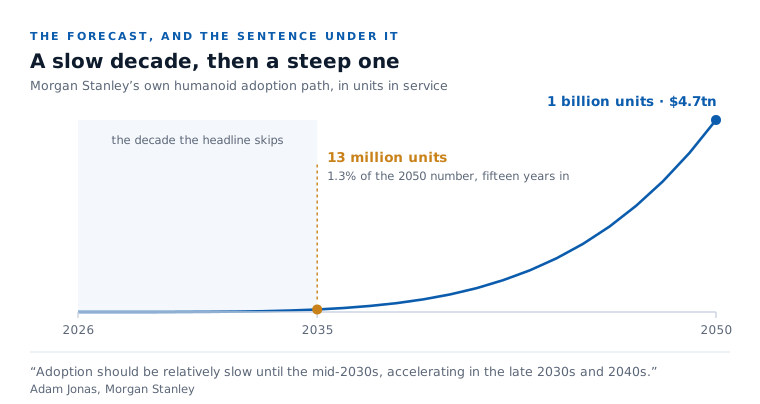
The forecast everybody quotes is Morgan Stanley’s: $4.7 trillion in humanoid revenue by 2050, roughly a billion units in service, with around 90% doing repetitive, structured work.
The sentence underneath gets quoted far less. The bank’s own published view is that “adoption should be relatively slow until the mid-2030s, accelerating in the late 2030s and 2040s,” and its 2035 figure is about 13 million units — a little over one percent of the 2050 number, fifteen years in.
Read together, that forecasts a slow decade followed by a steep one. The shipping data agrees: global humanoid shipments in the first half of 2026 came to roughly 19,100 units, up 272% on the year before. A genuinely fast curve, and a rounding error against a billion. Growing quickly and being early aren’t contradictions. They are the normal condition of everything that eventually mattered.
The Constraint Nobody Put in the Model
In July, 35,000 workers at Hyundai’s Ulsan complex — the largest car plant in the world — struck over Atlas, in what was the auto industry’s first humanoid-driven stoppage. Their demand wasn’t “no robots.” It was that no robot enters a Hyundai workplace without a prior labor-management agreement.
Read that as an engineer, and it is a scheduling constraint that no capability curve contains. You can solve dexterity. You can solve the data problem. You can’t solve, by building a better machine, the question of who agreed to it being there. The hardest part of a robotics program was never the robot, and anyone who has run one will tell you the same.
What to Watch Instead
In 1997, we set a goal: by 2050, a team of autonomous humanoids would beat the human World Cup champions. We are at the awkward middle of it, and the gap — as the reporting from Incheon put it plainly — is still huge. I’d rather say that out loud than have someone buy a robot on the strength of a highlight reel and find the gap themselves.
What I learned: the footage isn’t lying to you. It’s answering a different question than the one you are asking. A sprint measures commitment in a straight line; work measures judgment under uncertainty, among other people, over hours. We built our public intuition about humanoid robots almost entirely out of the first, and we are now using it to reason about the second.
Why it mattered: because real decisions are riding on this — factory floors, hiring plans, what a school buys, what a student decides to study. Those people deserve a better instrument than an eight-second clip. So don’t time the sprint. Time the recovery. And watch what the leagues make harder next year, because that is where the people who actually know how far away 2050 is quietly tell you the answer.
A sprint measures how fast a machine can commit. Work measures how fast it recovers. You can stage the first. You cannot stage the second.