In March 2025, New York added a question to the form a company must file before it lays people off. The question is whether technological innovation or automation contributed to the decision. It isn’t optional — not answering costs $500 a day per violation.
In the first year, more than 160 companies filed. Not one of them said AI.
Amazon filed. Goldman Sachs filed. Zero.
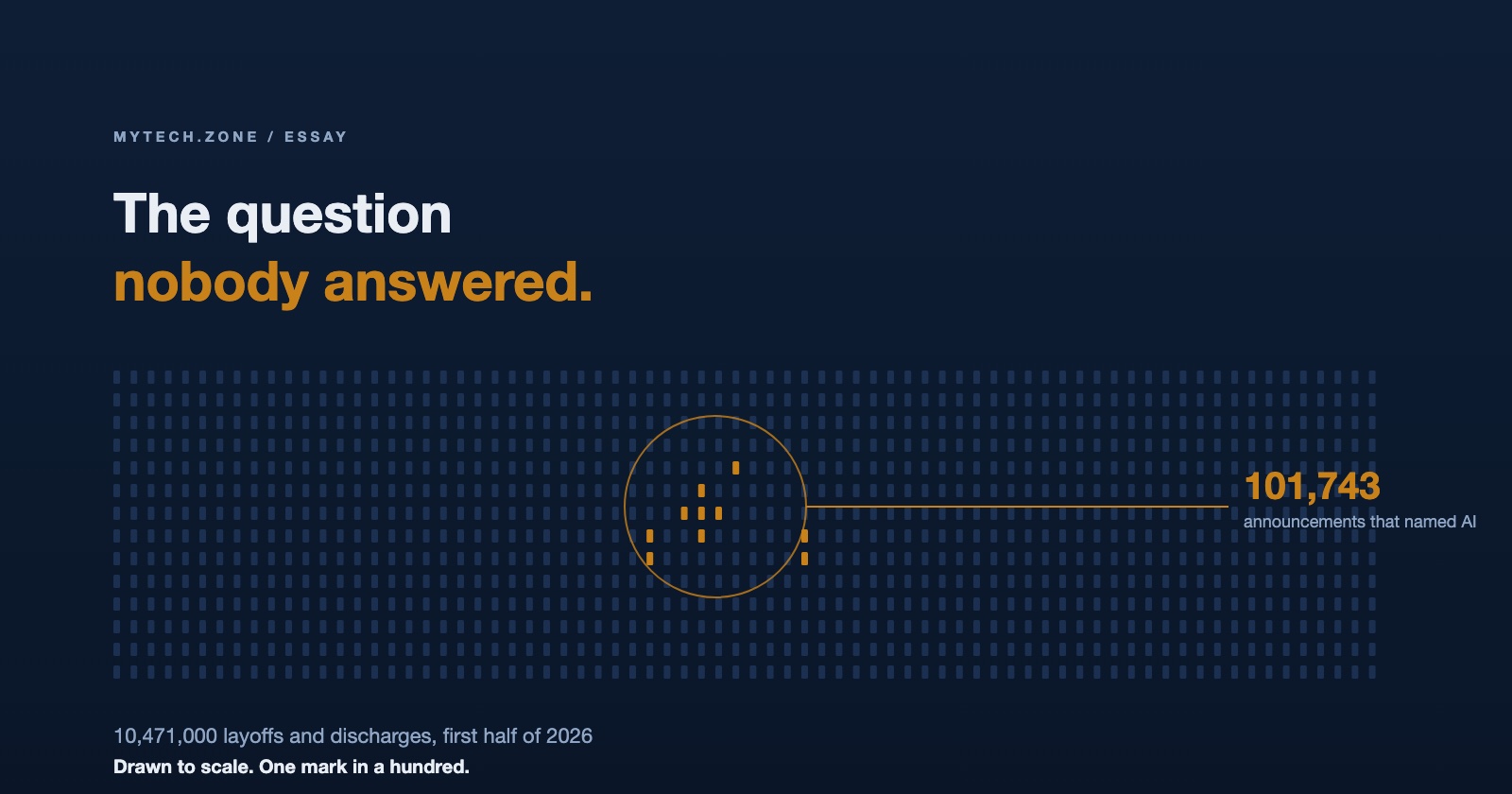
In the first half of 2026, Challenger, Gray & Christmas counted AI as the single most-cited reason for job cuts in America — 101,743 of them. Challenger builds that count from public announcements.
I can’t tell you those are the same layoffs. The two counts come from different places, and nobody reconciles them. That’s rather the point. One number is what companies tell a regulator who can fine them. The other is what they tell the market.
The AI layoff story is mostly a story. The cuts are real, and the spending is real, but the thing joining them in public is an assertion that costs nothing to make — and in the one place where making it carries a penalty, almost nobody makes it.
Here’s what convinced me.
It’s Smaller Than You Think
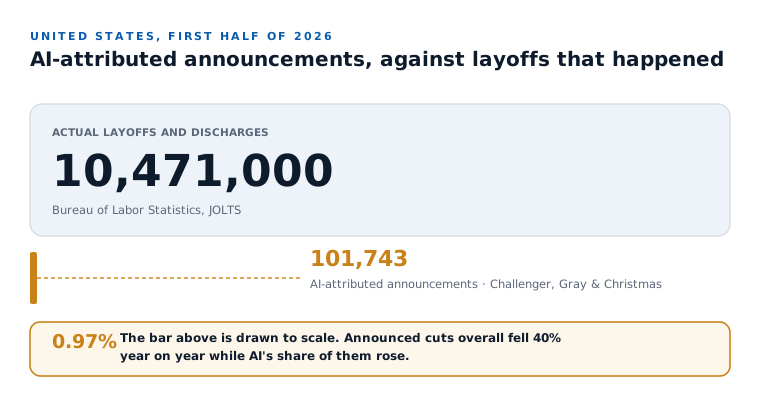
Challenger counted 101,743 AI-attributed job cuts in the first half of 2026. Over the same six months, the Bureau of Labor Statistics counted 10,471,000 actual layoffs and discharges.
AI-attributed announcements are under one percent of the layoffs that actually happened.
Announced cuts overall fell by forty percent year on year, while AI’s share of them rose. The story got louder as the thing it describes got smaller.
Meanwhile, six thousand senior executives — surveyed jointly by the Atlanta Fed, the Bank of England, the Bundesbank and a university research team — said something that doesn’t match the announcements: sixty-nine percent are actively using AI, and nine in ten report no effect on employment or productivity over three years. Their own forecast for the next three years is that AI reduces employment by seven tenths of one percent.
Goldman found that one percent of S&P 500 management teams have quantified AI’s impact on their earnings. One.
Challenger’s own report includes the sentence that explains the gap: naming AI in a layoff announcement can win over investors.
The Productivity Isn’t There to Carry It
This is the part I can speak to directly, because it’s my job.
I spend my days reviewing code that AI wrote, and I built the bar it has to clear before a human signs it. So I can tell you exactly where the speedup is.
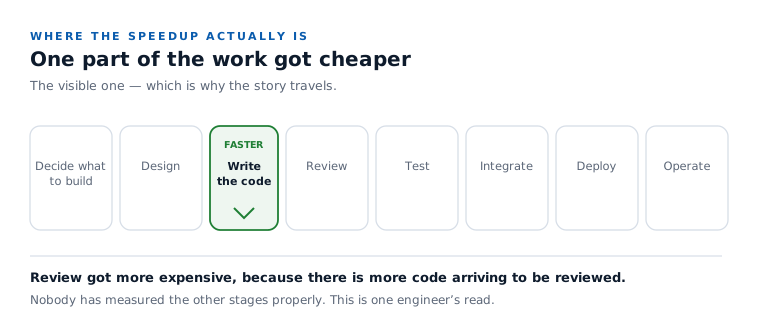
It’s in generation. Writing code got faster, genuinely and obviously, and anyone who tells you otherwise hasn’t used the tools properly. That part is real.
The rest of the pipeline, as far as I can see from where I sit, is where it was. Working out what to build. Deciding how. Reviewing. Testing. Integrating. Deploying. Keeping it alive at three in the morning. I haven’t found anyone who has measured those stages properly, so take that as one engineer’s read — but none of them got cheaper for me, and one, review, got noticeably more expensive, because there’s more code arriving to be reviewed.
Google’s own DevOps research program put it better than I can: AI “can speed up the initial bulk of the work (prototyping), but the remainder of the work (production integration) often neutralizes those gains.” They name the choke point too — reviewing code is harder than writing it, and AI raises the rate at which code shows up needing review.
Of everything I just listed, one part got compressed. It’s the most visible part, which is why the story travels.
And the people best placed to judge turn out to be poor judges. Researchers gave experienced open-source maintainers AI tools and measured them on real tasks in their own repositories. Beforehand, the developers expected to be about 24% faster. Afterward, they believed they had been about 20% faster. Measured, they were 19% slower.
Be careful with that number — that was sixteen developers, timing themselves, and when the same researchers ran it again with newer tools, they couldn’t reproduce it. Anybody quoting “AI makes developers 19% slower” in 2026 is quoting a figure its own authors have walked back. The finding that survived isn’t the magnitude. It’s the distance between expected, felt, and measured.
Now ask who decides a team can be smaller.
The Version I Believed, and Where It Breaks
I went in thinking companies were cutting people to pay for the AI buildout. It’s tidy, and it’s mostly wrong.
Meta cut about eight thousand roles in May 2026. Its capital spending is going up by somewhere between fifty-eight and seventy-three billion dollars this year. The payroll it removed is roughly a twentieth of that increase — a rough figure, because the only payroll number Meta publishes is a company-wide median. You can’t fund that with salaries, and nobody’s trying to — the five biggest builders issued $121 billion in corporate bonds in a year, up from an average of $28 billion in prior years. The buildout is being financed in the bond market.
It does hold at smaller scale. In May 2026, Cisco told the SEC it was restructuring about four thousand roles, and gave the purpose in the filing: to let it “invest in key growth opportunities including silicon, optics, security and artificial intelligence.” That’s a reason stated in a legal document, not to an analyst.
And then Salesforce, which kept me honest. It cut four thousand support roles and said so loudly. Its total headcount rose nine percent that year, and its margin improved.
Three companies, three different stories, and not one of them is the story you read.
We Have Watched This Film
Between 2000 and 2004, employment in Computer Programmer roles in the United States fell 24.3%, and the reason everyone gave was offshoring.
Between 2023 and 2025, employment in the same occupation fell 23.4% — and I should flag that the statistics agency publishing those figures discourages comparing them across years the way I just did. Take the shape of it, not the decimal.
Same title. Nearly the same number — twenty years and two completely different explanations apart.
The industry that was supposedly being hollowed out regained its previous peak by 2007 and, by 2023, employed 83% more people than before the panic. The title shrank. The work moved. Data Scientists — a job that barely existed in 2004 — grew 36% in the same recent window that programmers fell.
A falling job title is weak evidence of disappearing work, and we’ve been given this exact test before and scored badly on it.
The Part That Isn’t an Argument
None of this makes it hurt less.
Of the long-tenured American workers displaced between 2023 and the end of 2025, about two-thirds had found work again by January 2026. But among those back in full-time jobs, only about half were earning as much as before — down from roughly 62% in the survey before that. That count covers displacement of every kind; nobody tracks the AI-attributed cuts separately.
Whatever column the money moved to, a person lost a job, and of the ones who found full-time work again, about half are earning less than they were. That’s true regardless of which explanation turns out to be right, and any argument about budget lines that forgets it isn’t worth making.
What I’d Do With This
Stop reading the reason and start reading the filing. The announcement is written for investors. The WARN notice is written for a regulator who can fine you, and the two aren’t required to match. When they disagree, I’d weigh the one written under penalty more heavily — though the regulator’s own commissioner has said defining an AI-related layoff is genuinely hard, so a blank box isn’t proof of anything either.
And when someone tells you AI is about to take a class of work, ask them one question: which step? Not which job — which step. I can show you a step that got faster and seven that didn’t, and the difference between those two answers is the difference between a plan and a press release.
What I learned: I went looking for the money and found a narrative instead. The cuts are real. The spending is real. What isn’t real is the confidence with which they’ve been joined together — and I’d have carried on believing it if I hadn’t gone and checked.
So here’s the challenge. Next time you see a company say AI cost people their jobs, go and find that company’s WARN filing for the same layoff, and see whether they said it there. It takes ten minutes. Then decide what you think.