A Thesis, Reread Three Years Later
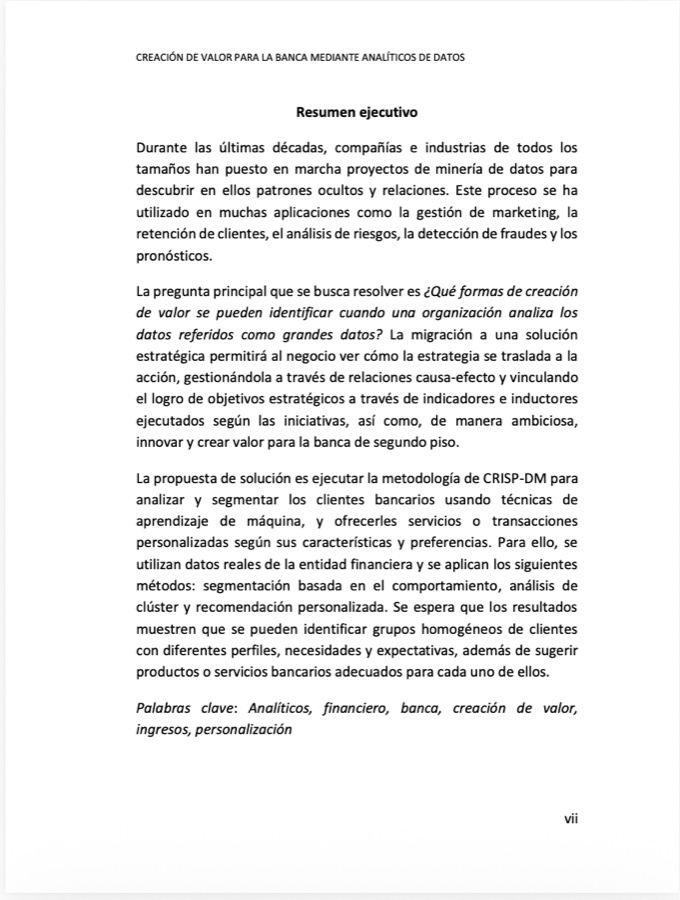
In 2023, I wrote a master’s thesis about creating value in banking with data analytics, artificial intelligence, and machine learning. The question at its center was almost quaint in its directness: what forms of value can an organization actually create when it analyzes its data? It answered with the disciplined machinery of the field — the CRISP-DM methodology, behavioral segmentation, k-means clustering, the argument that data should stop being treated as a cost to store and start being treated as an asset that creates value, with personalization and targeting as the engines. And — in a chapter I treated at the time as necessary due diligence — it spent real pages on data ethics, privacy, and governance.
I reread it recently, in the middle of the AI wave that has swallowed every conversation in my industry. And I had two very different reactions to two different parts of it.
The parts I was proudest of — the modeling, the technical machinery of extracting value — read, honestly, as a little quaint. Not wrong. Just no longer the hard part. The chapter I’d treated as an obligation — the one about ethics, privacy, and who’s accountable for what the system does — reads now like the most important thing in the document.
That inversion is the whole subject of this piece, and it’s a claim I’ll make plainly: in AI, the model was never the point. The value was always in the judgment and the governance around it — and the agentic era has finally made that obvious.
What Everyone Assumed Was Hard
Go back to 2023, or 2021, or almost any moment before the current wave, and the implicit assumption across the field was that the modeling was the scarce, valuable skill. The person who could build the classifier, tune the segmentation, wring signal out of noise — that person held the keys. My thesis reflected that assumption. So did the whole industry.
I’d actually already been taught otherwise, the hard way, and hadn’t fully absorbed it. Years earlier I’d won an internal innovation competition with an AI-driven business case that looked brilliant on paper. Then reality hit: the data we needed wasn’t accessible, the integrations were harder than anyone admitted, and the results didn’t come. We failed. And the lesson I took from that failure was the sentence I’ve repeated ever since: any good AI strategy starts with good data. The problem was never the algorithm. It was the foundation.
The thesis was, in a sense, me formalizing that lesson. But I still framed the data work as the setup and the modeling as the payoff. I had the order almost right and the emphasis wrong.
The One Idea That Only Got More True: Data → Information → Knowledge → Wisdom
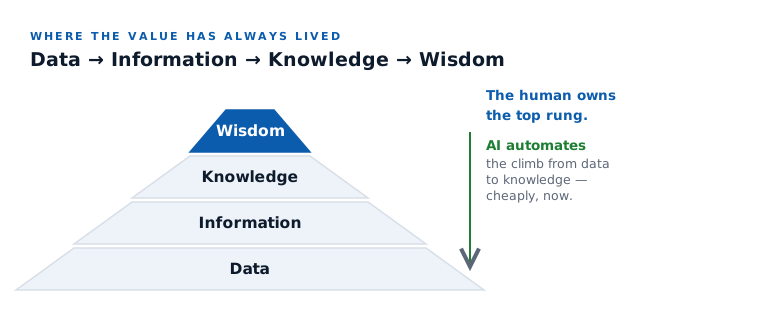
If a single idea from that thesis has aged into more truth rather than less, it’s a hierarchy I borrowed from the systems theorist Russell Ackoff. Value doesn’t live in raw data. It climbs a ladder. Data becomes information when you give it context. Information becomes knowledge when you understand the patterns in it. And knowledge becomes wisdom when you can judge what to actually do about it. Each rung is worth more than the one beneath it, and the top rung — wisdom, applied judgment — is where the value has always lived.
Here’s what the agentic era did to that ladder: it automated the bottom of it. AI is now extraordinary at turning data into information and information into knowledge — summarizing, classifying, finding patterns, building models. Those climbs used to be the scarce, expensive, human part. They’re cheap now.
What it did not automate — what it cannot automate — is the top rung. Wisdom. Deciding what the knowledge means, whether to act on it, who is accountable if you do. The machine climbs the ladder faster than we ever could, but it climbs to the human standing at the top, not past them. That’s the whole argument of this piece in one image: the tools got breathtakingly good at everything below wisdom — which is exactly why wisdom is now the entire job.
What the Agentic Era Made Cheap
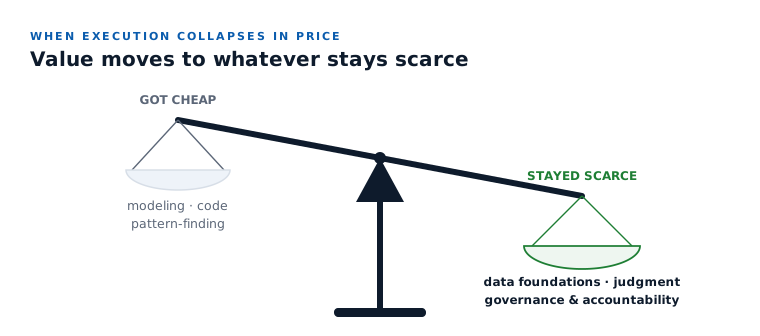
Then the modeling got cheap.
That’s the honest one-line summary of what’s happened. The part everyone assumed was the scarce skill — producing the model, generating the code, extracting the pattern — is now something a capable agent does quickly and well. Execution collapsed in price. And when the expensive thing suddenly becomes cheap, it stops being where the value lives. The value doesn’t vanish; it moves to whatever is still scarce.
Three things turned out to be still scarce, and they’re the same three my thesis half-saw:
Good data foundations. An agent can build you a model in an afternoon. It cannot give you data you don’t have, or make trustworthy data you’ve governed carelessly. The foundation is still the whole game, and it’s still human, slow work. My thesis actually spent its longest chapter here — not on models, but on the plumbing: one source of truth instead of dueling local spreadsheets, data quality controlled from capture to use, duplicate local systems retired. I thought that was the boring part. It turned out to be the load-bearing part.
Judgment about where value actually is. Deciding which problem is worth solving, which segment matters, what outcome the business should chase — that’s not a modeling question. It’s a judgment question, and judgment did not get cheaper. If anything, in a world where you can build almost anything quickly, choosing the right thing to build became the entire skill.
Governance, ethics, and accountability. This is the chapter that aged into gold.
The Chapter That Aged Into Gold
When I wrote about data ethics and privacy in 2023, it felt like the responsible thing to include — the section a serious paper should have. I did not imagine it would become the load-bearing part.
Rereading it now, the specific lines land differently than they did when I wrote them. I’d observed that clients love what analytics tells them about their own data but grow deeply uncomfortable the moment it’s used somewhere they didn’t expect — so protecting their privacy isn’t a nice-to-have; it’s the basis of the relationship. I’d set a bar for the data itself: it has to be credible, transparent, systematic, and verifiable. And I’d insisted that a governance model has to fix accountability — name who is answerable for how data gets used — and must never use data “in a way that is inconsistent with the expectations of clients and employees.” In 2023 I filed all of that under prudent boilerplate. In 2026, with systems that can act on that data at scale in seconds, it reads like the entire ballgame.
And it generalizes well past finance. The only thing standing between “powerful” and “harmful” is the human layer of judgment around the machine — who checks what, who’s accountable, what the system is and isn’t allowed to do, what it must disclose. The questions that felt like compliance boilerplate three years ago are now the questions that determine whether an AI system is trustworthy or a liability. Regulators are arriving at exactly this point; the industry’s hardest problems are now governance problems wearing technical clothes.
In finance, we have a word for the weight of this: fiduciary duty. When a system touches someone’s money, their savings, their financial life, you owe them more than a clever model. You owe them a defensible answer to “who decided this, and how do you know it’s right?” That’s not a modeling artifact. That’s a human accountability, and it’s the thing no amount of capability will ever produce on its own.
What I learned: I spent my thesis proud of the wrong chapter. The technical machinery I labored over became a commodity; the governance I treated as an appendix became the spine. Value in AI was never in the model. It was in the data beneath it and the judgment around it — both stubbornly, expensively human.
Why it mattered: it reshaped what I think an AI-literate engineer or leader actually needs to be good at. Not “can you build the model” — the machine wins that now. But “can you tell which problem is worth solving, insist on a foundation worth trusting, and stand behind what the system does when someone asks you to account for it.” That’s the job. It always was; the AI wave just stripped away everything else that used to disguise it.
The through-line of everything I’ve been writing — the same claim I made about engineering in From Vibe Coding to AI Engineering and about adoption in You Can’t Mandate an AI Transformation — is that autonomy is earned through human discipline, not handed over by better tools. Nowhere is that clearer than here. The tools got breathtakingly good at the part I once thought was the point. What’s left is the part that was the point all along.
The model was never the value. The data beneath it and the judgment around it were — and those never stopped being human.