The Robot That Couldn’t Move

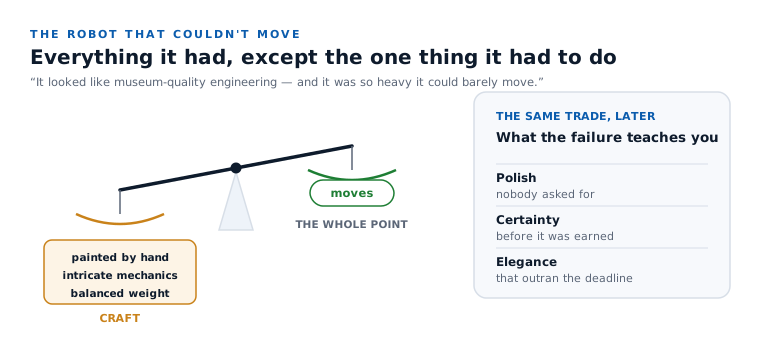
Years ago, I built a beautiful soccer robot for RoboCupJunior. It looked like museum-quality engineering — painted by hand, intricate mechanics, perfectly balanced weight distribution. Except for one fatal flaw: it was so heavy it could barely move.
I remember standing on the sideline, watching other teams’ robots zip across the field while mine trudged forward like a 40-pound brick with wheels. My students looked at me expectantly. I had no excuses. Just a spectacular failure in front of 500 international competitors.
But here’s what that moment taught me: the engineers and leaders who move fastest aren’t the ones who never fail. They’re the ones who fail in front of an audience and turn it into a learning moment.
That day, my team and I redesigned the robot. We stripped it down, rebuilt it lighter, and came back stronger. Fast forward through a decade of RoboCup leadership, and I’ve learned that every major breakthrough — whether in robotics competitions or building enterprise data platforms spanning seven continents — starts with someone willing to fail publicly and pivot quickly.
From Winning Pitches to Hard Truths: A VP’s Realization
Fast forward to today. I’m a VP, Senior Lead Software Engineer & Expert Engineer (E2) at JPMorgan Chase, coordinating global data platform strategy across 6 engineering centers from Jersey City to Singapore. I manage 16+ hour time zone coverage, balance US regulatory requirements with GDPR compliance and APAC market needs, and guide technical decisions across distributed teams.
On paper, it sounds like I have it all figured out.
The truth? I’m still that engineer learning from mistakes — just at a bigger scale.
A few years ago, I won JPMorgan’s internal Technology Originate competition with an AI-driven business case that looked brilliant on paper. The pitch was compelling. The technology was sound. The potential ROI was significant. We got the green light.
Then reality hit.
The data we needed wasn’t easily accessible. The integrations were more complex than anticipated. The results weren’t what we expected. We failed.
Instead of abandoning it or pointing fingers, I realized something fundamental: any good AI/ML strategy starts with good data. That’s when I made a career pivot — I took on the role of coordinating our data platforms. Not because I wanted to “fix” the failure, but because I understood that the real problem wasn’t the algorithm. It was the foundation.
That failure taught me that moving from engineer to executive isn’t about having perfect ideas. It’s about recognizing when the system needs a different approach — and being willing to step into that gap.
The “Popcorn-Scented Fireworks Display” Moment
Here’s another story my students won’t let me forget.
During an international robotics competition in Singapore, after days of working around the clock coordinating teams, managing logistics, and solving last-minute technical crises, I was exhausted. One night, I decided to charge all our team’s robots myself instead of trusting the students to handle it properly.
I thought I was being responsible. What I actually did was micromanage — and then, in my sleep-deprived state, I forgot to plug in the voltage converter before connecting the chargers to Singapore’s 240V outlets.
Within seconds, sparks flew everywhere — literal fireworks, chargers smoking, the smell of burnt electronics filling the air.
My students dubbed it “Bonilla’s Popcorn-Scented Fireworks Display.”
Did I want to disappear? Absolutely.
But here’s what that moment taught me: sometimes the biggest failures come from not trusting your team. I was so focused on “doing it right” that I didn’t let the students handle what they were perfectly capable of handling. And in my exhaustion, I made a basic mistake they probably wouldn’t have made.
That lesson stuck with me. Now, when I coordinate engineering teams across 6 locations and multiple time zones, I remind myself: trust the distributed team. Empower them to own their work. Your job isn’t to do it all — it’s to create the conditions where they can succeed.
What Changed When I Became a “Leader”
When I moved into leadership roles — first as a manager, then as a Senior Lead, and now as a VP — I noticed something unexpected:
The higher I climbed, the more I had to unlearn the “perfect engineer” myth.
As an individual contributor, being brilliant meant writing flawless code, delivering on time, avoiding mistakes. But as someone coordinating data platforms across multiple continents, working with teams across 16+ time zones, and influencing governance across regulatory frameworks, I realized:
- You can’t be perfect across 6 engineering centers.
- You can’t optimize for all three regions simultaneously.
- You can’t micromanage teams across four continents (and you shouldn’t try).
What you can do is:
- Fail fast and visibly — so teams learn from your mistakes instead of repeating them
- Create psychological safety — so your teams feel safe surfacing their own failures early
- Turn setbacks into strategic pivots — which is the only way you solve complex, multi-regional problems
- Model trust over control — especially when decisions affect 9+ international markets and multiple regulatory frameworks
The Real Work of Executive-Level Thinking
Here’s what nobody tells you about moving toward ED-level roles:
It’s not about knowing more. It’s about connecting more dots across greater complexity.
When I coordinate global data platform strategy, I’m not asking, “What’s the best cloud architecture?” (that’s important, but it’s engineering). I’m asking:
- “How do we design platforms that work for both US regulatory requirements AND GDPR AND APAC market needs?”
- “How do we build governance frameworks that give teams autonomy while ensuring compliance?”
- “How do we create learning cultures where failure becomes innovation across seven different engineering centers with different time zones, cultures, and business pressures?”
That’s the leap. And it only happens when you stop being afraid of failure and start being strategic about what you fail on — and what you learn from it.
Why I’m Still Teaching Robots (And Why It Matters to JPMorgan)

You might wonder: why does a VP at a major international bank spend 14+ years with a robotics organization?
Simple: RoboCup teaches me how to lead at scale.
Right now, as Trustee Board Member of the RoboCup Federation, I guide governance and strategic decision-making for 25,000+ students across 40+ countries. I help shape policy, mentor regional leaders, champion diversity initiatives, and build systems that scale globally.
Every lesson I learn there — how to lead without direct authority, how to influence across cultures, how to build inclusive systems that empower people in underrepresented regions — translates directly to how I lead at JPMorgan.
The bank teaches me precision and rigor. RoboCup teaches me human-centered leadership and global empathy.
Together, they’ve shaped how I think about executive-level impact: it’s not about being the smartest person in the room. It’s about orchestrating talent across complexity and turning setbacks into breakthroughs.
The Lesson Hidden in Every Failure

Here’s what I wish someone had told me earlier in my career:
The best leaders aren’t the ones with the fewest failures. They’re the ones who fail most intelligently.
They fail fast. They fail visibly. They extract the lesson. And they pivot strategically.
When I think about my recent promotion to VP, Senior Lead + Expert Engineer (E2) — a credential earned by less than 5% of technologists at the firm — it wasn’t because I never made mistakes. It was because I built a reputation for:
- Taking on complex, ambiguous problems (the kind where failure is likely)
- Failing, learning, and pivoting quickly
- Creating environments where my teams felt safe doing the same
- Scaling that learning across seven engineering centers and nine international markets
The Originate competition taught me that great ideas fail without good data foundations. Singapore taught me that micromanagement is just fear dressed up as responsibility. The heavy robot taught me that iteration beats perfection.
Every failure was a signal showing me where to focus next.
What This Means for You
Whether you’re an engineer trying to move into leadership, a manager stepping up to director level, or a leader aiming for the C-suite:
Your next level doesn’t come from perfection. It comes from strategic failure.
Ask yourself:
- What complex problem am I avoiding because failure is too visible?
- Where am I micromanaging when I should be trusting my team?
- What project that “failed” actually revealed the real problem I should be solving?
- Where am I optimizing for safety when I should be optimizing for learning?
The best engineers fail spectacularly. The best leaders fail strategically — and then invite everyone to learn from it.
If you’re building something worth building, you’ll fail. The only question is: will you hide it, or will you turn it into wisdom?
One Last Story
A few years into my RoboCup journey, after the heavy robots and electrical fires and competition missteps, a young student approached me during a workshop. They’d just watched their robot malfunction in the first round, and they were visibly upset.
“Roberto,” they asked, “are you ever scared you’ll mess up in front of everyone?”
I paused. Honest answer: “Every single day. But I’ve learned that the mess-ups teach us more than the perfect runs ever could. So I’m more scared of not trying hard enough than of failing.”
They looked at me, processing that. Then they said something I’ll never forget: “So if you mess up, it just means you tried something hard?”
“Exactly,” I said. “And that’s the only way we get better.”
That student went on to lead their regional robotics team and later studied engineering at university. Years later, they told me they still remembered that conversation — not because I was fearless, but because I was honest about my fear and did it anyway.
That’s executive-level leadership: being human enough to fail, brave enough to do it visibly, and wise enough to turn it into something greater.
The Path I Almost Didn’t Pursue
I’ll be honest: when the opportunity for VP, Senior Lead + Expert Engineer (E2) came up, part of me hesitated.
The E2 program is notoriously selective — less than 5% acceptance. It meant showcasing years of work, demonstrating strategic impact across the firm, and making a case for why I deserved recognition at that level.
What if I didn’t make it? What if my work wasn’t “good enough”?
Then I remembered Singapore. I remembered the Originate competition. I remembered every robot that failed on the field and every team that came back stronger.
The biggest risk wasn’t failing to get the credential. It was not trying because I was afraid of failure.
So I applied. I showed up. I made the case.
And when I earned the E2 credential and the promotion to Senior Lead, I realized: the promotion wasn’t the reward for never failing. It was recognition that I’d failed intelligently, learned strategically, and built systems that helped others do the same.
That’s what executives do. They don’t avoid failure — they architect systems where failure becomes insight.
So, Go Build Something Worth Breaking
Now, go build something worth breaking. Take on the complex problem. Trust your team. Fail in front of an audience. Pivot strategically.
Your next breakthrough is hiding inside your next failure.
And when you do fail (because you will), remember: you’re not failing. You’re just gathering data for your next strategic move.
If someone had told me 14 years ago that burnt robot chargers and a failed AI pitch would become the foundation of my leadership philosophy, I wouldn’t have believed them.
But here we are. VP, Senior Lead, E2 credential, 6 engineering centers, 9+ international markets, 25,000+ students across 40+ countries.
Built on a foundation of spectacular, strategic, visible failures — and the wisdom to turn every one into forward momentum.
Now it’s your turn. What are you going to break next?
About the Author
Roberto Bonilla is Vice President, Senior Lead Software Engineer & Expert Engineer (E2) at JPMorgan Chase’s International Private Bank, where he coordinates global data platform strategy across 6 engineering centers spanning Jersey City to Singapore. He also serves as Trustee Board Member of the RoboCup Federation, guiding governance for a global community of 25,000+ students across 40+ countries.
Recently promoted to Senior Lead and awarded the elite E2 credential (<5% acceptance), Roberto believes the best innovations happen at the intersection of world-class engineering, human-centered leadership, and the willingness to fail spectacularly in service of something greater.