In 2002, two people wrote down how RoboCupJunior should be organized. Reading it now, seventeen years after I first walked in as a participant, I kept finding the rooms we built — and the ones we never did.
The document is seventeen pages long. Elizabeth Sklar was an assistant professor at Columbia University and chaired that year’s international RoboCupJunior event. Brian Thomas ran educational programs in Melbourne and chaired RoboCupJunior Australia. Together, they organized the competition’s first three years. In May 2002, they sat down to answer the question every young organization eventually has to answer: who decides, who represents whom, and who pays?
It was never published. It’s a proposal, the kind of document that gets circulated, discussed, and then quietly overtaken by events. It ends with the minutes of two organizational meetings, in Melbourne in 2000 and Seattle in 2001 — robot sizes, a $50 kit versus a $300 one, and more than one line that reads “No conclusion was drawn.”
The part that didn’t age at all
The first thing that stopped me was the mission. Sklar and Thomas wrote that RoboCupJunior exists “to create a learning environment for today, fostering understanding among humans and technology for tomorrow.”
We could publish that sentence this week, and nobody would notice it was 24 years old.
The same goes for the four principles underneath it — learning, sharing, teamwork and fun ahead of winning; challenges accessible to everyone; mentors on the sidelines, not at the controls; and open sharing of what teams build, “in the spirit of Linux.” Every one of them still shows up on a competition floor.
The rooms we built as drawn
Some of their design is standing almost exactly where they put it.
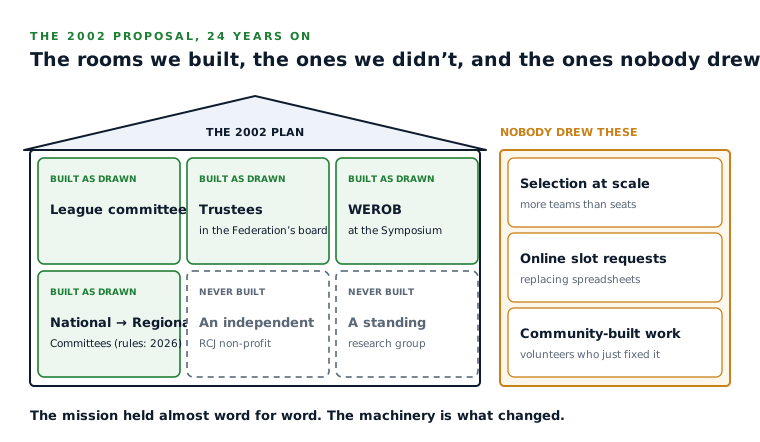
They wanted the competition owned by the people who run it, and today each league — Soccer, Rescue and OnStage — has its own committee, partly elected by the community, with rules that keep any one region from dominating. They wanted Trustees looking after RoboCupJunior, and there are — inside the RoboCup Federation’s own board rather than as a separate one. They wanted educational research to have a place at the RoboCup Symposium. Since 2010, it has had an annual workshop, today called WEROB, and since 2025 it has also put Junior’s work on posters next to the Symposium’s.
And they wanted a committee in every country — they called them National Committees — so that local events, qualification, and standards had someone responsible for them. That took a long time. It changed its name along the way, from National to Regional, and it only got real rules for accreditation, renewal, and public reporting in February 2026.
The rooms we never built
The proposal expected RoboCupJunior to become its own international non-profit, with a president, a treasurer and an annual general meeting. It didn’t. RoboCupJunior stayed within the RoboCup Federation, and I’ve come to think that was the better outcome — but that’s a story for the next essay.
The second missing room is the one the authors cared about most. They imagined a research group that would take every new idea through a cycle: pilot it small, field-test it at a real event, then make it official. That cycle still happens. I’ve lived it — Rescue Simulation started as a league-development proposal I co-wrote in 2018 and is now a sub-league with its own teams. But it happened because specific people pushed it through, not because a group existed whose job was to run that cycle on purpose.
The rooms nobody planned
Then there are the parts of today’s organization that appear nowhere in the 2002 document — because nobody in 2002 could have seen them coming.
The proposal handed qualification to the national committees almost in passing. Nobody could have planned for how big that job would become — for the moment when far more teams would want to come than the international event could hold. In 2002, the problem was getting enough teams to show up. Today, more than 700 teams can enter RoboCupJunior competitions in a single country in one year — and fewer than ten of them reach the world championship. Deciding fairly who goes became one of the organization’s hardest jobs.
Nobody planned for slot requests and invitation letters to move from spreadsheets to an online platform, or for what that took.
And nobody planned for how much of the organization would end up being built by its own community — by volunteers, referees and mentors who saw a problem and fixed it without waiting for a structure to tell them to.
What I took from it
What I learned: The purpose in a founding document lasts longer than its structure. Sklar and Thomas got the mission exactly right, while much of the machinery they proposed changed shape along the way — which is what happens when you design for a community that doesn’t exist yet.
Why it mattered: Most of us work inside teams, systems, and processes somebody else designed, for reasons nobody wrote down. The temptation is to treat the current structure as if it were the point. Reading the 2002 proposal reminded me to go looking for the original intent first. When you know what the founders were trying to protect, it’s much easier to tell which parts of the structure are load-bearing and which were just a guess.
Over the next four weeks, I want to walk through the rest of the house: why RoboCupJunior never left home, how a region decides who travels, where the research half ended up, and what our community wrote on the walls when we gave them a pen.
Whatever you’re running that someone else designed, the oldest document about why it exists is worth an evening. You might be surprised how much of it you’d still sign.