The Cascarita
There’s a word in Mexican Spanish for a casual pickup game of soccer — a cascarita. No referee that matters, no standings, no glory. You play because playing is the whole point.
This July, in Incheon, South Korea, I played a cascarita against humanoid robots.
I was on a team of RoboCup trustees — for the second time now, humans versus humanoids — sharing a field with machines that walk on two legs, see with two cameras, and decide, entirely on their own, what to do with a ball at their feet. I’ve spent over fifteen years in this federation, from a nervous kid competing in RoboCupJunior to a seat on the Trustee Board. And there I was, laughing, out of breath, playing keep-away with robots and with people I’ve built this thing alongside for half my life.
I’ll be honest about two things at once, because both are true. The robots aren’t good yet — not the way you’re picturing. For a friendly game like ours, they’re deliberately slowed right down, so no one gets hurt on the way to the ball — not a human, not a robot — and even then they stumble and lose it. But here’s what’s changed: when they go down, they get back up fast now, faster every year. And it was one of the most joyful hours I’ve had in years. There is still so much work to do — and we had an absolute blast doing a cascarita more than an official game.
That contradiction — historic and humbling, breakthrough and pratfall, all at once — is exactly what a fifty-year moonshot looks like when you catch it at the halfway mark.
What Actually Happened in Incheon
But the cascarita wasn’t the headline. The headline came later that same day, and it was history.
On July 5, 2026, for the first time ever, two full teams of eleven humanoid robots played an 11-vs-11 soccer match on a real field. Two German university teams — B-Human from Bremen and HTWK Robots from Leipzig — lined up eleven-a-side, on the same Booster humanoid hardware, and played. B-Human won, 4–0. No human touched them during play. Never before had two full-sized humanoid teams lined up eleven-a-side against each other.
To understand why grown roboticists teared up over a 4–0 exhibition, you have to go back to 1997. That was the year IBM’s Deep Blue beat world chess champion Garry Kasparov — and a group of scientists looked at that and decided chess wasn’t hard enough. Chess is a closed, abstract world. They wanted a challenge that married body and brain, AI and robotics, in a messy, unpredictable, physical arena. So they set an outlandish goal: by 2050, a team of humanoid robots that can beat the human World Cup champions — and win.
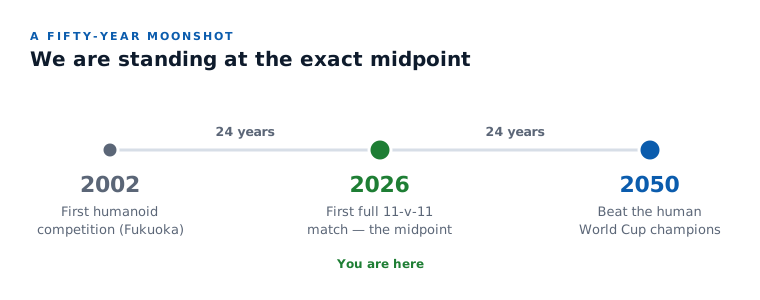
The first humanoid competition, in Fukuoka in 2002, wasn’t a game at all — just fragments, a few limited challenges. For over two decades, an eleven-a-side humanoid game stayed out of reach. And here’s a symmetry I can’t unsee: from that first humanoid competition in 2002 to this first eleven-a-side match in 2026 is exactly twenty-four years — and from here to the 2050 goal is another twenty-four. We’re standing, almost to the year, at the precise midpoint. This year, we finally passed the milestone. As our federation’s president Ubbo Visser put it: “This match shows how far humanoid robotics has come… the new humanoid hardware paired with the new level of intelligence provided by AI puts humanoid robot soccer on another level.”
Or, in the line from the announcement that I can’t stop thinking about: it may be only a small kick for a human, but it is a huge goal for robotics.
The Awkward, Necessary Middle
Here’s what I want people outside our world to understand, because the highlight reels won’t tell you: the midpoint of a moonshot is not glamorous. It’s the least glamorous part.
At the start, a moonshot is a beautiful idea on a slide — “robots that beat the World Cup champions” — and beautiful ideas cost nothing. Near the end, presumably, it’s polished and inevitable. But the middle? The middle is robots falling over. The middle is a 4–0 game that would lose to a team of seven-year-olds. The middle is where the dream has to survive contact with reality — actuators and balance and battery life and a ball that doesn’t care about your research paper.
And that’s precisely why the middle matters most. Anyone can love a moonshot at the poster stage. The people who get it to 2050 are the ones who can stand on a field of clumsy, falling machines and see, clearly, both how far it is and how far it’s come — and keep going. This year, for the first time, the thing that was pure science fiction in 1997 walked onto a pitch and played. Badly. Historically. Both.
Reimagining the Whole Thing
None of this happened by inertia. The reason eleven-a-side was even possible is that the federation spent the last stretch reimagining RoboCup itself — and this year the first part of that landed: a single, integrated Humanoid Soccer League, consolidating what used to be separate size classes into one path aimed squarely at the 2050 game.
I won’t pretend that kind of change is easy in a global volunteer organization with decades of tradition. It isn’t. But watching it come together on the floor in Incheon was, to borrow the only word that fits, electric — the sense that a thirty-year-old institution had just made itself younger and more focused on the same afternoon it made history.
Why the Cascarita Was the Point After All
So let me come back to that pickup game, because I’ve realized it wasn’t a sideshow. It was the whole thesis.
We could have staged a serious, officiated humans-versus-robots exhibition. Instead, the best part of it was a cascarita — imperfect, joyful, human. And that, to me, is the soul of this entire fifty-year project. The 2050 dream is not really about robots. It’s about the tens of thousands of people — the researchers, the volunteers, the students who’ll inherit it (more on them in a piece to come) — who show up, year after year, to move an impossible goal a few clumsy meters down the field, and to have fun doing it.
The machines are the medium. The people are the point. When two robot teams finally played eleven-a-side, what I saw wasn’t the future arriving; I saw thirty years of human stubbornness and joy, standing on a field, taking a small kick.
A moonshot doesn’t feel like triumph from the inside. It feels like a lot of falling down, a lot of getting back up — fast, faster every year — and, if you’re lucky and you built the right community, a lot of laughing while you do it. The falling isn’t the failure of the dream; it’s the dream, in progress.
In 1997, 2050 was in the clouds. This July, it took a step. A small kick — and a huge goal.
Halfway to an impossible goal, the robots played their first real game, and the humans played a cascarita. Both were the point.